Supportive Measures are individualized services, accommodations, and other assistance that the College offers to any students or employees and may be put in place without fee or charge.
Supportive Measures are designed to restore or preserve equal access to the College’s programs and activities, protect the safety of all parties and the College’s educational environment, and/or deter Prohibited Conduct, without being punitive or disciplinary in nature or unreasonably burdening the other party.
Supportive Measures are available regardless of whether the matter is reported to the College for the purpose of initiating a proceeding under College policy and before, after, and regardless of whether a Formal Complaint is filed. A Reporter who requests Supportive Measures has the right to file a Formal Complaint, either at the time the Supportive Measure is requested or at a later date. The College will also implement Supportive Measures for Respondents as requested and appropriate.
Supportive Measures may include, but are not limited to, the following to the extent reasonably available and appropriate:
For Students:
- Academic measures, such as, assistance in transferring to another section of a course, assistance in requesting withdrawal or an incomplete grade in a particular course, leaves of absence or withdrawal from the College, or assistance requesting alternate methods of completing coursework;
- Housing measures, such as requiring a Student to relocate College housing assignment pending the outcome of a conduct investigation or proceeding. This may also include facilitating changes from an on-campus housing location to alternate housing, and assistance in exploring alternative housing off-campus.
- Employment measures, such as, arranging for alternate College employment, different work shifts, etc.;
- Arranging a meeting with the Office of Title IX & Sexual Misconduct and/or Campus Police Services to discuss or report alleged violations of Prohibited Conduct;
- Arranging a meeting with the Office of Anti-Violence Initiatives and/or Campus Police Services to discuss safety planning;
- Arranging access to counseling and/or medical services and assistance in setting up initial appointments;
- Transportation or parking accommodations;
- Restorative practices, which would include voluntary participation in a discussion by trained facilitators with any persons or departments harmed and development of a shared agreement of how to correct the Harm;
- Any other measure that may be arranged by the College (to the extent reasonably available) to ensure the safety and well-being of a Student and/or the College community affected by the Prohibited Conduct;
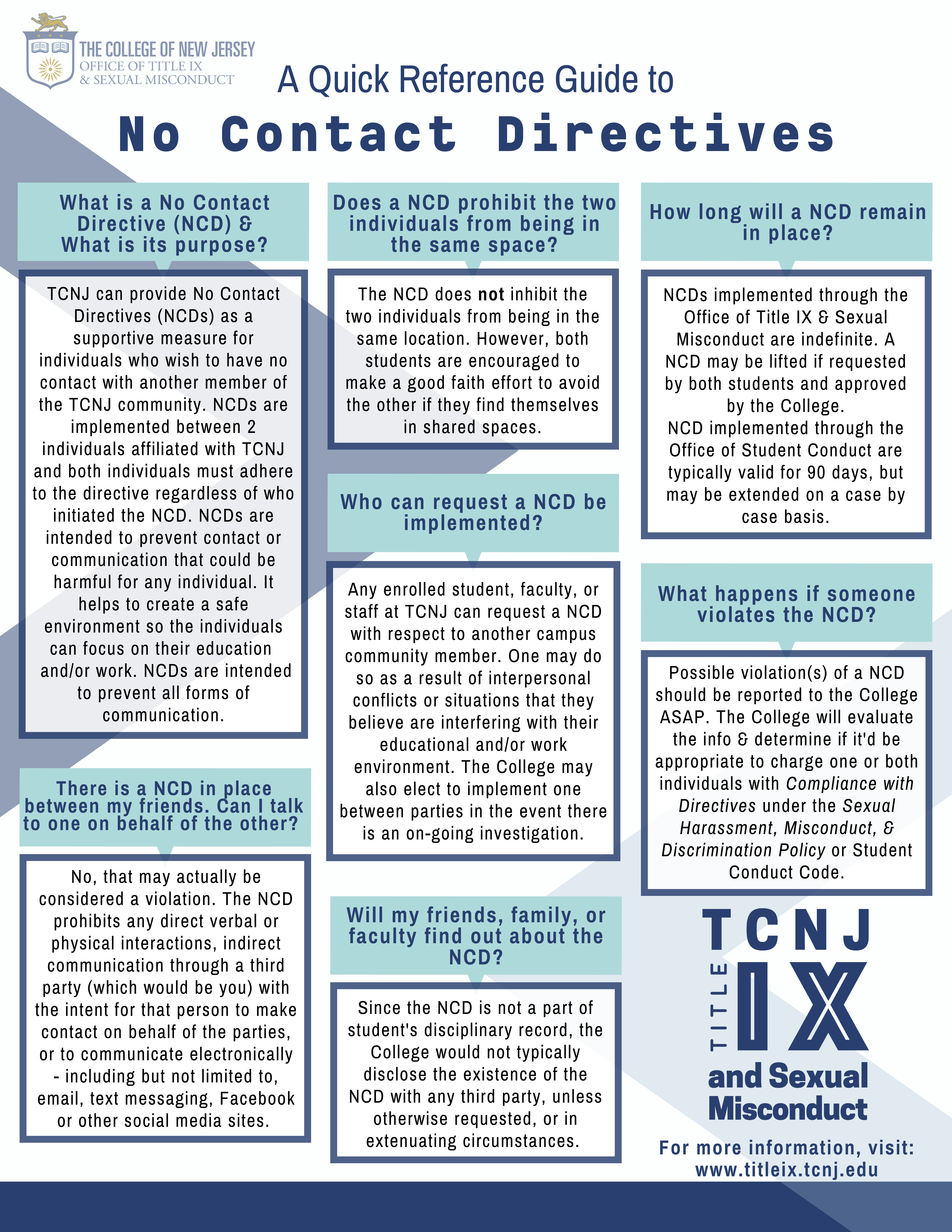
- Implementation of a No Contact Directive (see below for more information on these directives).
For Employees:
- Employment accommodations, such as temporary assignment, if appropriate, to other work duties and responsibilities, or other work locations, or other work groups/teams or alternative supervision/management;
- Arranging a meeting with the Office of Title IX & Sexual Misconduct, EEO, and/or Campus Police Services to discuss or report Prohibited Conduct;
- Arranging a meeting with Campus Police Services to discuss safety planning;
- Arranging access to counseling and/or medical services and assistance in setting up initial appointments;
- Transportation or parking accommodations; and
- Any other measures that may be arranged by the College (to the extent reasonably available) to ensure the safety and well-being of an employee who has been affected by a Title IX Sexual Harassment outlined within this Policy.
If you are interested in any of these measures please contact:
- Title IX Coordinator, Dr. Chelsea Jacoby, at jacobyc@tcnj.edu | 609-771-3112; or
- Assistant Director of Sexual Misconduct & Student Conduct Investigator, Caitlin Babcock, at babcockc@tcnj.edu | 609-771-2613